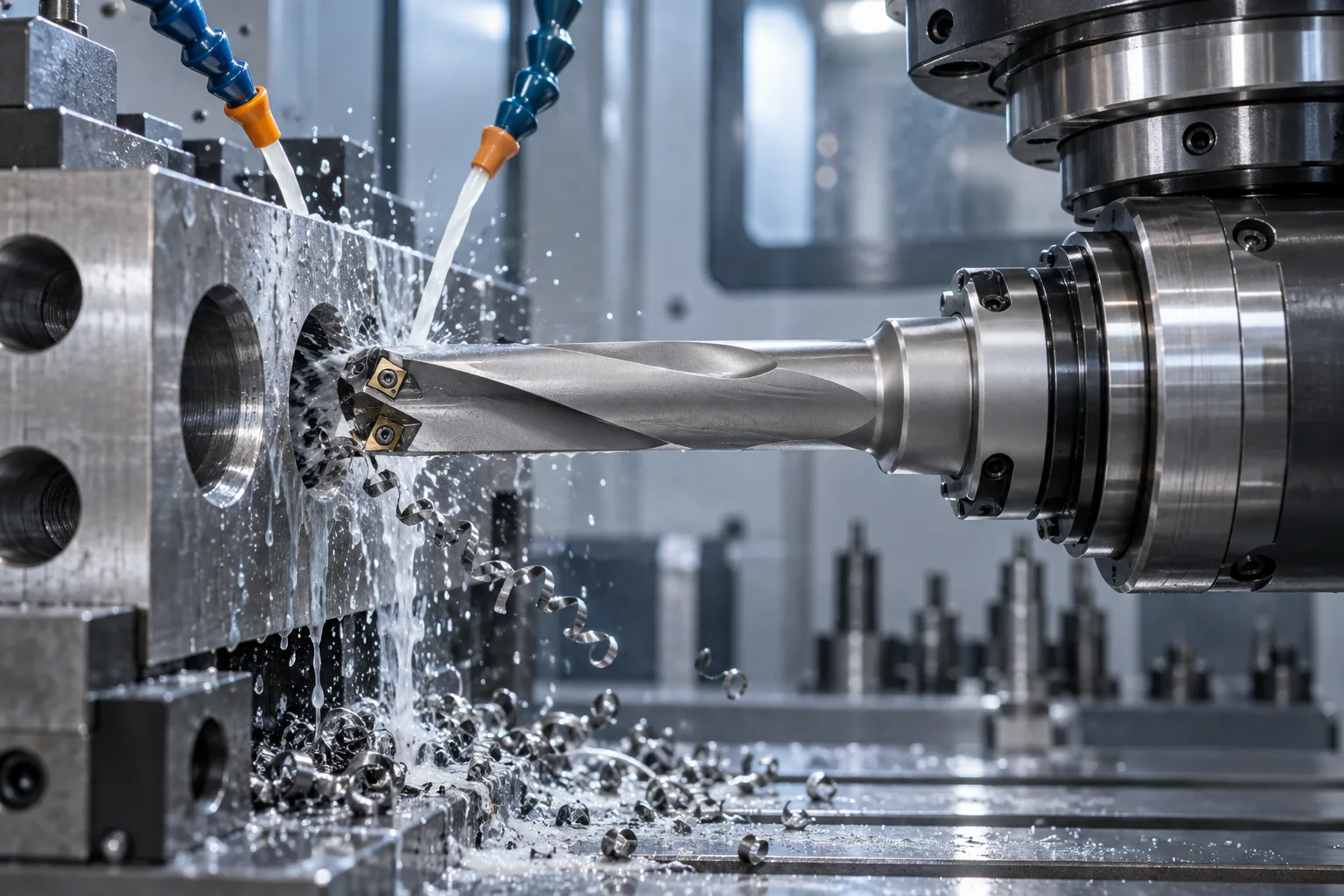
Choose an indexable U drill by matching hole diameter, depth, workpiece material, machine capability and coolant delivery to a specific drill body and compatible inserts. Use the shortest approved body that reaches the cut. The term U drill does not establish a universal deep-hole capability.
What is an indexable U drill?
An indexable U drill uses replaceable cutting inserts in a drill body. Many systems use different center and peripheral cutting positions; follow the body instructions for insert placement. It differs from a solid twist drill and from an interchangeable-head or crown drill. Do not assume their replacement components are interchangeable.
For the differences between replaceable cutting systems, see crown drill versus indexable U drill. Select by the complete body and cutting-unit configuration, not by overlapping catalog diameter ranges.
Define the hole before selecting the body
Specify finished diameter, depth, through or blind condition and the entry and exit surfaces. Cross holes, angled entries, stacked plates and interruptions can change the operating requirements. Establish whether a separate finishing operation is needed for the drawing tolerance and surface finish.
| Selection factor | What to check |
|---|---|
| Diameter and depth | Confirm the exact body size and rated depth combination; a series range does not prove every combination exists. |
| Material | Identify the alloy and hardness where known, then select the recommended insert grade and chipbreaker. |
| Machine and holder | Check shank interface, tool clearance, spindle capability, rigidity and runout. |
| Coolant | Confirm the manufacturer required delivery, pressure, flow and filtration for the selected body. |
| Replacement parts | Record body model, insert codes, center/peripheral positions and fastening components. |
Check reach and chip evacuation
A longer body is generally less rigid than a comparable shorter body. Use the reach required by the part rather than the longest option in the catalog. For deeper holes, verify the approved coolant arrangement and operating method. Do not invent a pecking cycle or apply one automatically: interruptions and re-entry can be unsuitable for a particular insert system.
Set cutting data from the selected system
Use the tool supplier starting recommendations for the exact insert, material and body diameter. Confirm the distinction between cutting speed, spindle speed and feed per revolution. Account for machine limits and observe chip formation under controlled conditions. Avoid transferring a speed or feed from a different material or drill system.
Diagnose problems before changing the tool
For poor chip evacuation, inspect coolant delivery, blocked passages and insert geometry. For oversize or unstable holes, review runout, alignment, tool holding and edge condition. For edge damage, check insert seating, fastening, entry conditions and operating data. Stop and inspect the tool when abnormal vibration, chip packing or cutting-edge damage occurs.
Confirm deep-hole suitability
A body advertised for deep drilling still needs configuration-specific approval. Confirm the rated drilling depth, coolant requirements, hole condition and machine capability with the supplier. Some applications require a purpose-designed deep-hole drilling system rather than a general indexable U drill.
Compare body types in the U drill and CNC drilling catalog. Identify replacement cutting edges in the insert catalog only after confirming the body designation.
Request a tooling recommendation
Provide diameter, depth, hole condition, material, machine interface, coolant capability, drawing requirements and quantity. Send your requirements to Wujinniu for configuration and availability confirmation.
Frequently asked questions
Is a U drill the same as an indexable drill?
A U drill is a type of indexable drill using replaceable cutting inserts. Other drilling systems may use different cutting and replacement mechanisms.
Can I use the same inserts in any U drill?
No. Match the insert designation, seat and cutting position to the specific drill body instructions.
Can an indexable U drill handle every deep hole?
No. Verify the rated depth and coolant requirements for the exact body; some holes need a dedicated deep-hole system.
Choose a configuration for your application
For indexable U drilling, compare the SP 8–80 mm drill and separately listed 6–12 mm SP drill. If your application calls for a crown system, review the ICD crown drill and confirm its own body and cutting-component connection. These listings represent different configuration choices, not interchangeable parts.