
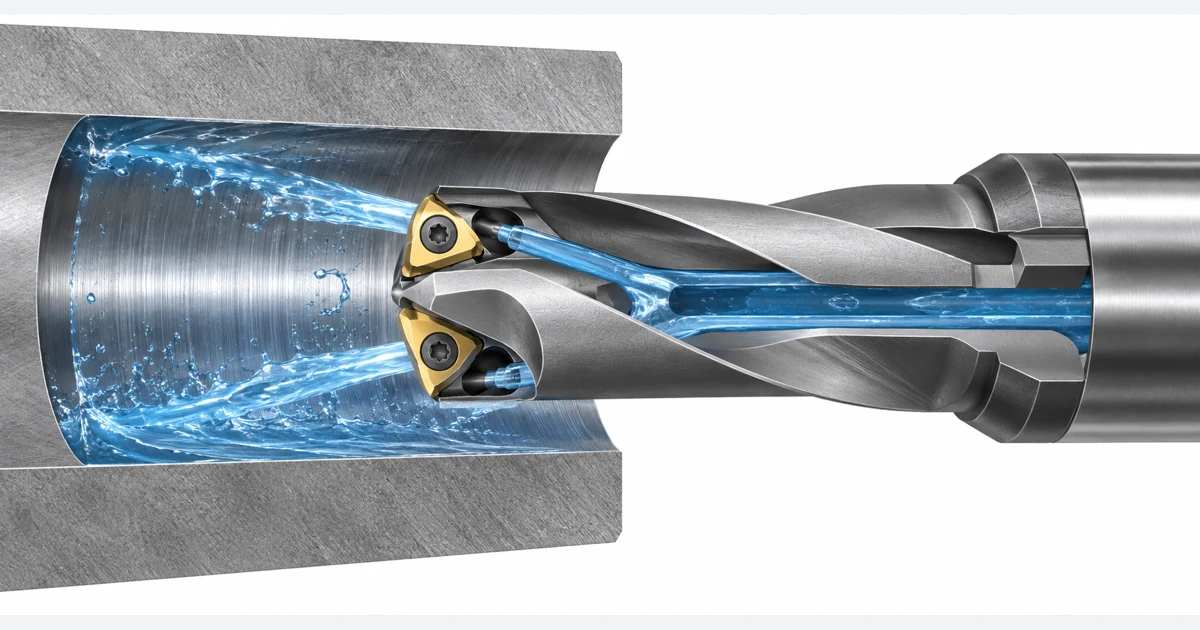
Featured image: AI-generated conceptual illustration, not a product drawing or a record of a machining trial.
Indexable drill coolant requirements depend on the drill, cutting diameter, depth, workpiece material and machine delivery system. Confirm pressure and flow for the exact configuration at the tool, together with filtration and coolant condition. A pump rating alone does not establish that coolant reaches the cutting edges and carries chips out of the hole.
Pressure and flow answer different questions
Pressure helps drive coolant through restrictions; flow describes the volume delivered over time. A system may show pressure while delivering inadequate flow through a restricted connection or small passage. Check the complete route from pump and filter to spindle, holder and tool outlets.
Use the tool maker’s requirements for the selected body, inserts and depth. Do not copy a pressure value from a similar-looking drill. Mitsubishi Materials’ drilling troubleshooting guidance identifies coolant volume, pressure and internal delivery among the measures to review for chip dispersal. It does not provide one setting for every indexable drill.
Collect these requirements before the first cut
| Item | Confirmation needed |
|---|---|
| Tool configuration | Body, cutting diameter, insert system and depth option |
| Pressure and flow | Tool-maker requirements and available delivery under operating conditions |
| Filtration | Filter requirement compatible with the tool passages |
| Coolant condition | Fluid type and maintenance guidance from the relevant suppliers |
| Connections | Holder seals, inlet arrangement and unobstructed outlets |
| Machine limits | Rated pressure, permissible connections and approved checks |
Do not open pressurized lines or improvise a flow test. Have qualified personnel verify delivery using the machine’s approved procedure. A leak, blocked outlet or incompatible holder can invalidate an otherwise suitable pump specification.
Treat depth and chip evacuation as part of the choice
As the chip path becomes more demanding, the tool and process need a suitable evacuation strategy. Confirm whether through-tool coolant is required and which drilling cycle the manufacturer permits. Blind holes, interrupted entry and difficult chip behavior deserve specific review.
Do not add pecking automatically to an indexable-drill program. Likewise, do not assume external flooding can substitute for required internal delivery. Follow the application guidance for the actual cutting system, including any limitations on entry, pilot holes and withdrawal.
What the related product listings establish
The SP series listing gives an 8–80 mm cutting-diameter range and 2D–6D options. The small-diameter SP listing gives 6–12 mm cutting diameters and through-tool coolant. These are series descriptions, not a promise that every diameter is offered at every depth. Neither establishes a universal pressure, flow or insert designation.
A crown drill is a separate cutting system. The local ICD listing gives an 8–38 mm range and several depth options, but its exact connections and coolant requirements still need configuration confirmation. Do not transfer coolant or assembly instructions from another maker’s exchangeable-head drill to it.
Use symptoms to guide a controlled review
Chip packing, unstable chip discharge, surface damage or edge damage justify stopping to inspect the process. Review the insert condition, material, cutting guidance and coolant path together. Do not respond by increasing pressure beyond machine or component ratings.
For a supplier enquiry, send the chosen drill configuration, hole drawing, material, coolant system details and observed chip behavior. Ask for the required delivery conditions and permitted cycle. Record the confirmed values with the setup so future operators can distinguish a tool requirement from an assumption.
Frequently asked questions
What coolant pressure does an indexable drill need?
Use the requirement for the exact drill configuration and application. There is no single pressure that applies to every indexable drill.
Is pressure more important than flow?
Both matter. Pressure at a gauge does not prove adequate flow through the tool or effective chip evacuation.
Can I use the same coolant setup for a crown drill?
Confirm it separately. Cutting systems, passages, connections and depth options can differ even when the cutting diameters are similar.
Related selection resources
Crown versus indexable drill systems
Technical references and scope
- Drilling – Technical Info | MITSUBISHI MATERIALS CORPORATION
- TAW – Technical Info | MITSUBISHI MATERIALS CORPORATION
Manufacturer references explain general selection principles or their own systems; they do not certify another supplier’s compatibility or performance. Product ranges above come from the linked local listings. This guide does not replace instructions for the exact assembly. Sources reviewed October 27, 2026.
Technical information is prepared by the Wujinniu CNC tooling team based on product application data and machining requirements.