
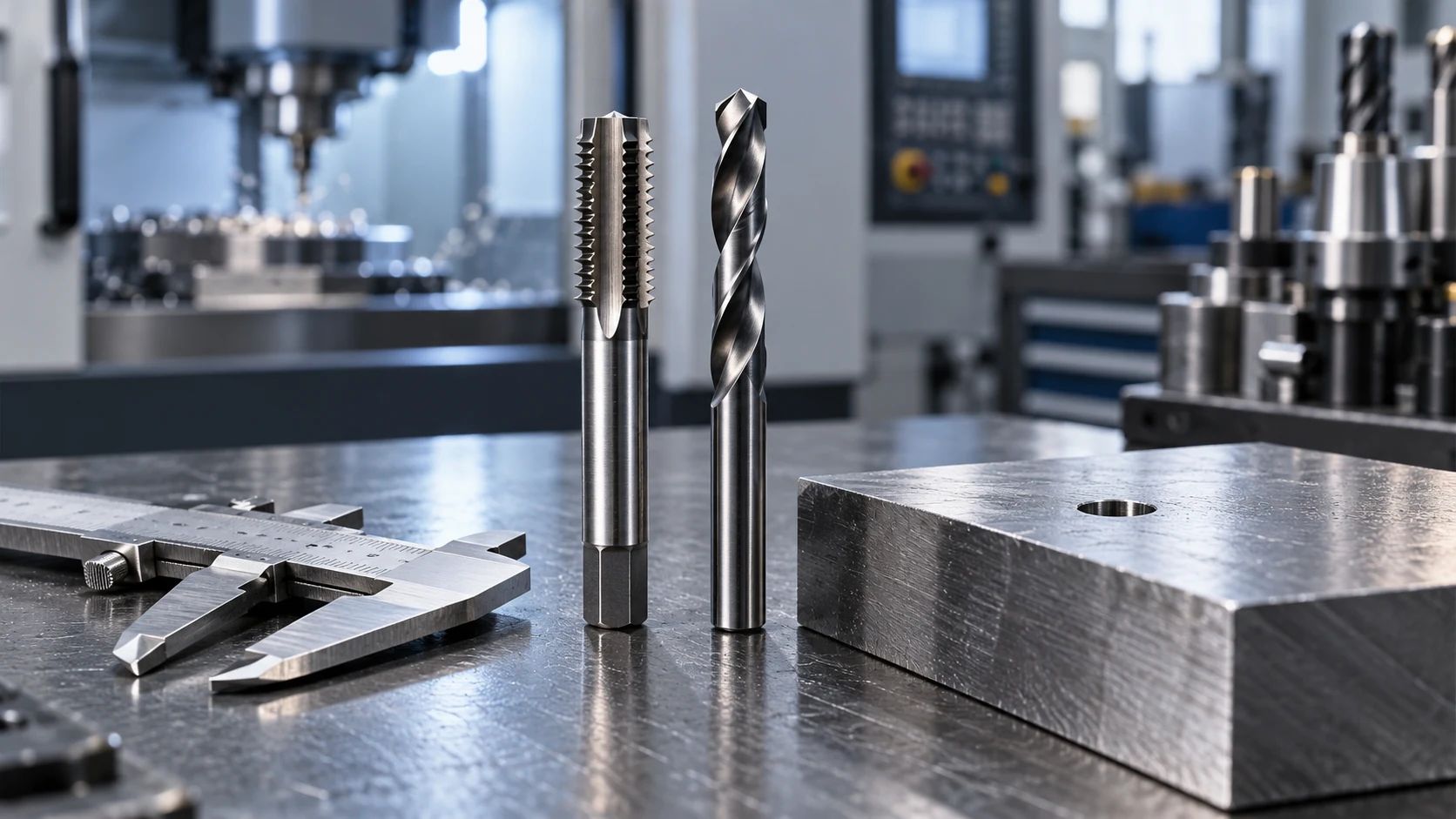
A 5.0 mm drill is a common starting choice for an M6 × 1.0 cutting tap. Confirm the thread pitch, tap type, material and required thread engagement before machining. This size is not a recommendation for an M6 forming tap.

M6 cutting tap drill chart
The nominal diameter minus pitch rule gives a useful approximate starting diameter for cutting taps. The values below are calculated starting points, not a replacement for the tap manufacturer chart or drawing requirements.
| Thread | Pitch | Calculated starting drill diameter |
|---|---|---|
| M6 × 1.0 (coarse) | 1.0 mm | 5.0 mm |
| M6 × 0.75 (fine) | 0.75 mm | 5.25 mm |
| M6 × 0.5 (fine) | 0.5 mm | 5.5 mm |
How the approximation works
For a nominal 6.0 mm thread, subtract the pitch in millimeters: 6.0 − 1.0 = 5.0 mm. A different pitch changes the starting hole. M6 alone is insufficient when the drawing specifies a fine thread. Read the full designation and check that the tap marking matches it.
Cutting taps and forming taps need different preparation
A cutting tap removes material to make the thread. A forming tap displaces material and normally requires a larger, more closely controlled pre-hole for the same nominal thread. Do not apply the cutting-tap chart to forming taps. Use the forming-tap manufacturer recommendations for the material, lubrication and engagement requirement.
Check actual hole size and blind-hole depth
The diameter on the drill shank is not proof of the finished hole size. Runout, drill condition and workpiece behavior can affect the result. Inspect the pre-hole where the process requires it. For a blind hole, allow for the drill point, tap chamfer, chip space and required full thread length; these depths are not interchangeable.
Why taps break or threads fail inspection
An undersized pre-hole can increase tapping torque, while an oversized hole can reduce engagement. Poor alignment, unsuitable lubrication, packed chips and an incorrect pitch setting can also cause problems. Check the tap style, material suitability, actual hole size and chip evacuation before changing the nominal drill diameter. Confirm the completed thread with the inspection method specified on the drawing.
For related holemaking tools, browse the drilling tool catalog and check the actual tool type and diameter. An M6 thread does not imply that an indexable U drill is appropriate for preparing its tap hole.
Request a tooling recommendation
For a drilling-tool inquiry, state the full thread designation, tap type, workpiece material and hole depth. Send your requirements to Wujinniu for configuration and availability confirmation.
Frequently asked questions
What size drill should I use for an M6 × 1.0 cutting tap?
5.0 mm is a common starting size. Confirm the tap manufacturer recommendation for the material and required thread engagement.
Can I use 5.5 mm for every M6 tap?
No. The diameter-minus-pitch approximation gives 5.5 mm for M6 × 0.5 cutting taps. It is not a general M6 drill size.
Can I use this chart for M6 forming taps?
No. Forming taps require their own pre-hole recommendation, usually larger and more tightly controlled than for cutting taps.