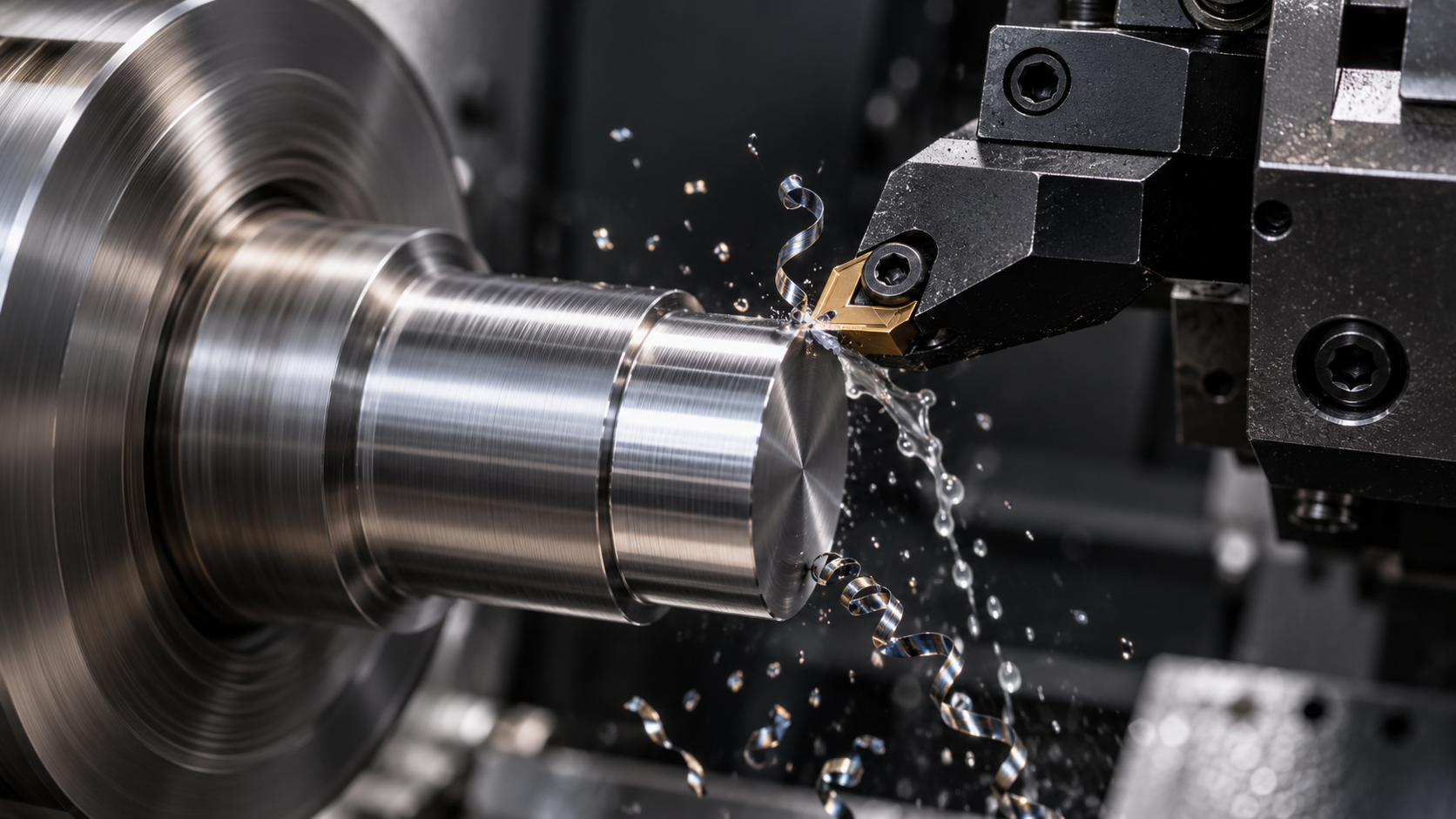
Choose an OD turning tool by starting with the cut, not the holder name. Identify the surface and shoulder to be machined, then check approach angle, handedness, clearance, insert and machine fit. A holder that can turn a straight diameter may not reach the adjacent profile without interference.
Describe the cutting task on the drawing
Mark straight turning, facing, shoulder work, profiling and interrupted sections separately. State the workpiece material and known condition. Identify whether the pass removes rough stock or produces a finished surface. This prevents a general external-turning holder from being treated as equally suitable for every operation.
Check the available stock and the required direction of travel. A tool should reach the feature while keeping the holder body, insert flank and nearby turret stations clear. Use the complete assembly outline when checking a shoulder or a recessed feature; the cutting point alone does not describe access.
Read angle and hand together
The holder’s approach or entering geometry influences access and the direction in which cutting forces act. The angle stated in a title is only one part of the geometry. Compare it with the actual holder drawing and the intended feed direction rather than selecting the largest or smallest angle as universally better.
Handedness also needs the machine context. Right-hand and left-hand holders are not simply labels for which side of a photograph the tool occupies. Confirm the proposed orientation, spindle rotation, feed direction and turret arrangement. Mitsubishi Materials’ holder-identification guide separates cutting angle, insert shape, clearance and hand for this reason.
Use a selection matrix before comparing prices
| Selection input | Question to resolve |
|---|---|
| Operation | Which surfaces and shoulders must this tool cut? |
| Machine interface | Will the shank and holder fit the station at the required center height? |
| Geometry and hand | Can the edge follow the programmed path with clearance? |
| Insert | Does the exact designation match the seat and material requirement? |
| Support | Can the assembly work with practical projection and adequate workpiece support? |
| Service parts | Are the correct screws, seats and replacement inserts identified? |
Do not treat the insert family as the final selection. Size, thickness, hole, seat and fastening details still need verification. Select cutting grade and geometry from the insert maker’s recommendations for the actual material and operation.
Where an SDACR/L holder fits the discussion
The related local listing describes a 93° SDACR/L external-turning holder with DCMT-series inserts and right- or left-hand options. Those are useful starting facts. They do not confirm an exact shank size, insert size or a match for every shoulder in the drawing.
Request the full designation and drawing of the chosen version. If a quote offers a substitute, repeat the interface and cutting-envelope checks. Do not approve a replacement merely because both descriptions contain “external turning” or the same angle.
Prove the setup before production
After assembly according to the tool instructions, verify offsets, center height, fastening and clearances using the machine’s safe prove-out procedure. Inspect the edge and coolant route. Use cutting guidance for the selected insert, material and actual setup; the holder name alone cannot supply a safe speed or feed.
For a purchasing enquiry, send the marked drawing, material, station details and proposed cutting direction. Ask the supplier to identify the holder, exact insert and any required seat or screw. A complete selection record is more valuable than an unsupported promise of high precision.
Frequently asked questions
Is a 93° holder suitable for every OD operation?
No. Check the feature, tool path, approach geometry, hand and complete assembly clearance against the drawing.
Can any insert in the same family be fitted?
No. Confirm the full insert designation, size, thickness, seat and fastening compatibility for the specific holder.
Which information should I provide for selection?
Provide the part drawing, material, operation, machine station, intended feed direction and required result.
Related selection resources
SDACR insert compatibility checklist · Turning and boring tools
Technical references and scope
Manufacturer references explain general selection principles or their own systems; they do not certify another supplier’s compatibility or performance. Product ranges above come from the linked local listings. This guide does not replace instructions for the exact assembly. Sources reviewed October 27, 2026.
Technical information is prepared by the Wujinniu CNC tooling team based on product application data and machining requirements.