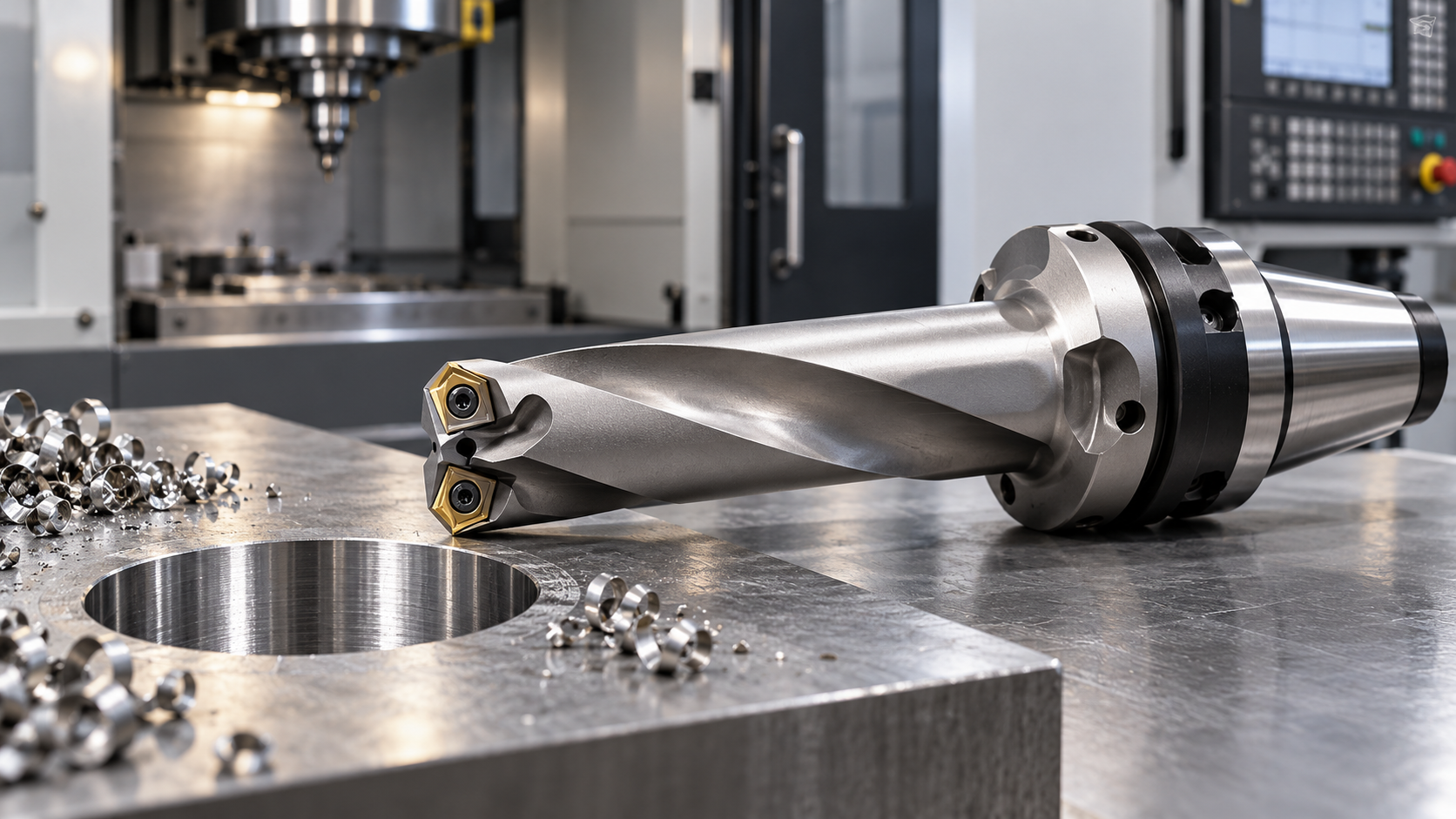
A high-precision SP U drill is selected by the complete drilling system: diameter, depth ratio, insert geometry, holder, machine rigidity and coolant delivery all matter. This guide explains how to evaluate an SP indexable U-drill before production drilling and how to separate confirmed product information from application data that still requires verification.

What is an SP U drill?
An SP U drill is an indexable CNC holemaking tool that uses replaceable inserts in a dedicated tool body. The system is intended for repeatable drilling where the body, insert seats and coolant arrangement are matched. “High precision” should be evaluated through the required hole tolerance, setup runout, machine condition and the manufacturer’s application guidance rather than assumed from the product name alone.
Confirmed SP U-drill range
The local Wujinniu listing for the High Accuracy SP U-Drill confirms an 8–80 mm diameter range and 2D, 3D, 4D, 5D and 6D depth options. It is listed for wet drilling. The product record also identifies an SKD61 / 42CrMo body, black oxide, plating and QBQ finish options, and HRC48–50 hardness. These details apply to that listing; they should not be generalized to every SP U-drill configuration.
Choose diameter and depth ratio
Start with the finished hole diameter and required depth. Then select a tool diameter and depth ratio that cover the application without excessive overhang. A 2D tool and a 6D tool have different chip evacuation and rigidity demands. Confirm whether the stated depth ratio is a maximum, a recommended range or an application-dependent value in the technical drawing.
Check workpiece and machine compatibility
Steel, aluminum, stainless steel and mold materials can require different insert grades and cutting data. Confirm the machine interface, spindle condition, holder, clamping length, runout and coolant capability. A rigid setup helps the insert cut consistently; excessive runout can affect hole size and insert wear even when the nominal tool diameter is correct.
Wet drilling and chip evacuation
Wet drilling is part of the confirmed SP listing, but coolant pressure, flow and direction still need to be matched to the machine and hole depth. Monitor chip shape and evacuation during the first holes. If chips recut or pack in the bore, review coolant delivery, feed, depth strategy and insert geometry before increasing cutting speed.
For the machine-side checks, use the indexable drill coolant setup checklist to review delivery, flow, filtration and connections. Obtain the exact requirements for the chosen configuration rather than adopting a universal pressure value.
SP U-drill selection checklist
- Confirm finished hole diameter and required depth.
- Select the appropriate 2D–6D depth option for the setup.
- Match insert geometry and grade to the workpiece material.
- Confirm holder interface, runout, clamping length and machine rigidity.
- Confirm wet-drilling coolant flow and the manufacturer’s speed and feed chart.
Frequently Asked Questions
What diameter range is listed for the Wujinniu SP U drill?
The local product listing confirms an 8–80 mm diameter range. Confirm the exact available size and drawing before ordering.
What do 2D to 6D options mean?
They describe drilling depth relative to tool diameter. The practical limit depends on the tool, workpiece, machine rigidity, coolant and chip evacuation.
Can I use the same cutting data for every SP U-drill size?
No. Cutting data depends on diameter, insert grade, workpiece, depth, coolant and machine conditions. Use the applicable manufacturer chart.
Technical information is prepared by the Wujinniu CNC tooling team based on product application data and machining requirements.
Choose a configuration for your application
For the listed series and configuration checklist, view the SP 8–80 mm indexable U drill. Specify diameter, hole depth, shank interface, material and coolant capability when requesting a quotation.