
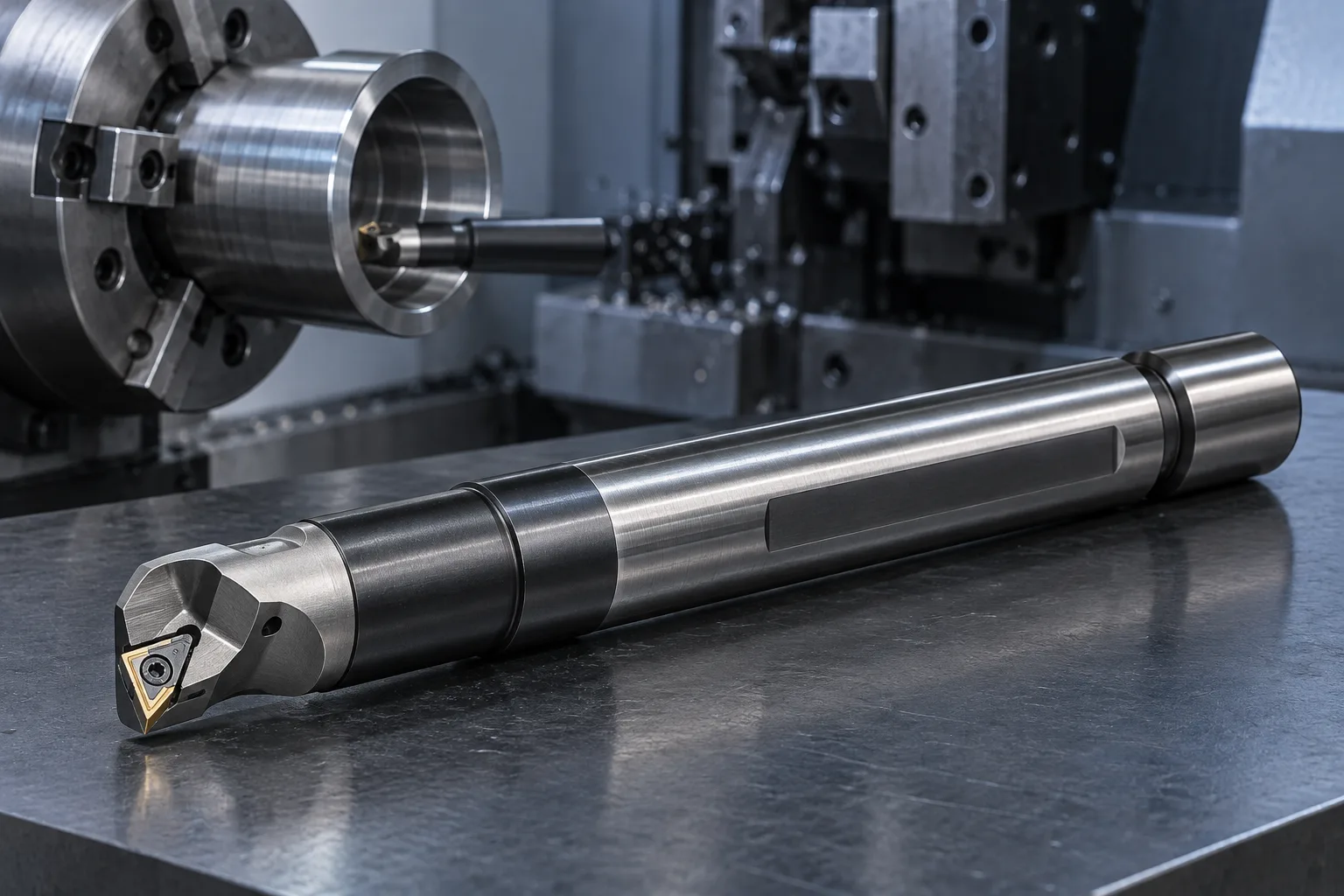
Vibration damping in a boring mill starts with locating the flexible or unstable part of the machining system. The cutting assembly, spindle or ram, fixture and workpiece can all contribute. A damped boring bar is one possible tool-side measure; it is not automatically compatible with every boring mill or a cure for workpiece vibration.
Identify the operation before selecting a remedy
“Boring mill” can describe different machine arrangements and cutting assemblies. Record whether the tool rotates, which component feeds, how the spindle or ram is extended, and how the workpiece is supported. A lathe-style internal-turning bar and a rotating boring assembly have different mounting and application requirements.
Document the feature, tool path, material, insert, projection and point where vibration begins. Check for an interrupted cut, uneven stock or a weak section of the part. These observations help locate the problem without claiming a diagnosis from the sound alone.
Separate tool, workpiece and machine evidence
| Area | Questions to check | Useful evidence |
|---|---|---|
| Tool assembly | Is projection excessive? Are joints seated? | Assembly drawing, holder and edge condition |
| Workpiece and fixture | Does the problem follow a thin or unsupported region? | Clamping layout and mark location |
| Spindle or ram | Does behavior change with extension or operating state? | Machine setup and maintenance observations |
| Cutting process | Are stock, chips or edge condition changing? | Process log and inspected surface |
Inspect only under the machine’s safe maintenance procedures. Suspected spindle damage or abnormal machine vibration belongs with qualified maintenance personnel. Do not attempt to compensate for a mechanical fault by changing a cutting tool.
Correct the support path first
Review fixture contact, workpiece support, tool-holder seating and unnecessary extension. A long unsupported feature may move under load even when the tool is stable. Conversely, a rigid workpiece does not prevent a slender tool from vibrating. The remedy should address the component identified by the evidence.
BIG DAISHOWA’s vibration guidance explains the importance of tool length, machine stability and workpiece support. Apply the underlying support principles carefully; do not transfer a lathe-specific assembly recommendation to a boring mill without checking its interface and permitted use.
When a damped tool is worth evaluating
Consider a suitable damped assembly when tool reach is unavoidable and the system supplier supports the intended operation. Ask for machine-side fit, rotation suitability where relevant, head connection, permitted projection, coolant route and clamping procedure. Confirm any speed or balance restrictions for rotating use.
The related local damped boring bar is listed for CNC internal turning. Its listing does not establish boring-mill or rotating-spindle compatibility. It can support a discussion about damping options, but it must not be presented as a drop-in boring-mill solution. Obtain written confirmation for the complete assembly.
Validate the correction with measured results
After correcting a mechanical or support issue, run a controlled trial using the required inspection method. Record surface appearance, bore dimensions and repeatability under the same documented conditions. Change one factor at a time within tool and machine guidance.
If the symptom persists, provide the machine and fixture arrangement, tool projection, insert, material and trial log to the appropriate supplier. A successful correction may involve workpiece support, a different cutting assembly or maintenance. Choosing the category of remedy before locating the problem risks repeating the same unstable setup.
Frequently asked questions
Will a damped lathe bar fit a boring mill?
Not necessarily. Confirm the mounting interface, operation, rotation suitability and complete assembly limits with the supplier.
Can damping solve a flexible workpiece?
Tool damping does not remove workpiece flexibility. Review the fixture and workpiece support when evidence points to that side of the system.
Should abnormal spindle vibration be treated as chatter?
Do not assume it is only a cutting-process issue. Follow safe machine procedures and involve qualified maintenance personnel when a machine fault is suspected.
Related selection resources
Related internal-turning damping option · Boring-bar specification worksheet · Boring-tool category
Technical references and scope
- Your Ultimate Guide to Reduce Vibration in Machining
- Anti-Vibration Boring Bars – Damping Bars From BIG DAISHOWA
Manufacturer references explain general selection principles or their own systems; they do not certify another supplier’s compatibility or performance. Product ranges above come from the linked local listings. This guide does not replace instructions for the exact assembly. Sources reviewed October 27, 2026.
Technical information is prepared by the Wujinniu CNC tooling team based on product application data and machining requirements.