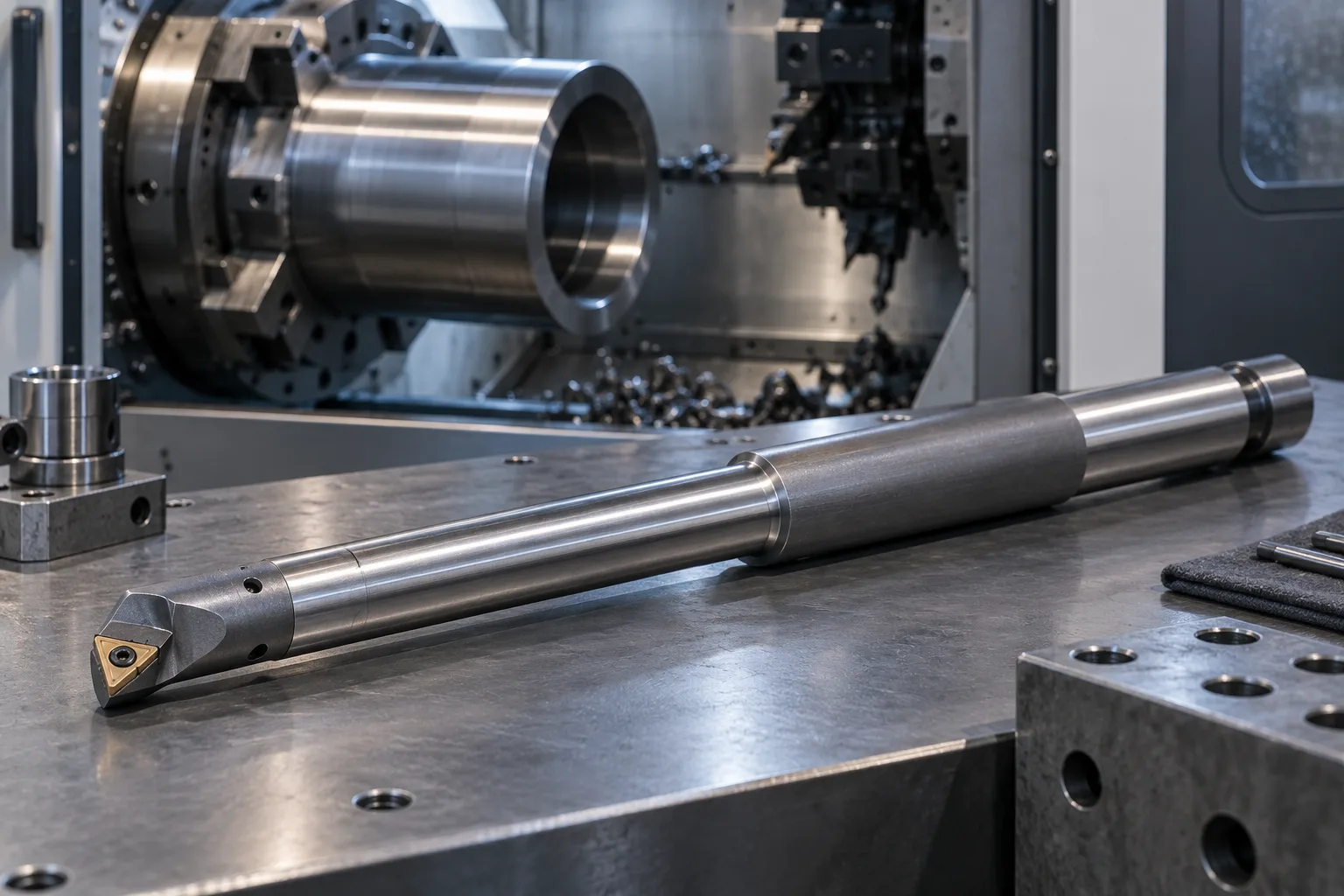
Specify a damped boring bar as a complete machining assembly, not just a diameter and a request for anti-vibration performance. The quotation should connect the bore drawing, machine interface, cutting-edge reach, head and coolant arrangement. Missing information should remain a supplier question rather than becoming an assumed specification.
Start with the feature and acceptance criteria
Provide the component drawing or a controlled sketch showing the bore, depth, shoulders, entry, exit and any interruptions. Identify the reference surfaces used for inspection. Include the required tolerance and surface-finish designation exactly as shown on the drawing; do not replace them with a general request for high precision.
State the workpiece material and its known condition. If hardness, heat treatment or casting condition is unknown, mark it as unknown and ask what information is needed. Those details affect tool and insert selection. Distinguish a finishing operation from material removal before a later finishing process.
Copy this enquiry worksheet
| RFQ field | What the buyer supplies | What the supplier confirms |
|---|---|---|
| Feature | Bore drawing, depth and access restrictions | Proposed cutting path and clearance |
| Machine | Model, station and mounting interface | Holder and connection designation |
| Reach | Required cutting-edge position | Permitted projection and clamping zone |
| Material | Material grade and known condition | Suitable head and insert options |
| Quality | Tolerance, finish and inspection method | Trial conditions and acceptance approach |
| Coolant | Available delivery arrangement | Connection and tool-specific requirements |
Add a column for “not yet confirmed” in your own worksheet. An unresolved field is visible work to complete, not permission to copy a value from a similar product. Ask the supplier to return the worksheet with its proposed assembly drawing.
Define reach without hiding the support requirement
Show the distance needed to place the cutting edge at the deepest feature. Separately show the available holder location and station envelope. Let the supplier identify the corresponding bar length, clamping engagement and head arrangement.
A product photograph cannot establish these dimensions. Nor can an unqualified length-to-diameter ratio establish suitability across different bars, heads and operations. BIG DAISHOWA’s holder and damping-bar material illustrates why interfaces and application-specific assemblies deserve attention, but the actual assembly needs its own limits.
Make the offer configuration-specific
Request a list of the bar, holder, sleeve, head, insert, screws and coolant fittings included in the offer. Ask which are consumables and which must be ordered separately. Confirm that replacement parts use the exact designation, not merely the same nominal size.
For the related local damped-bar listing, intended CNC internal-turning use is established; a complete dimensional selection is not. Treat it as the starting point for an enquiry. Do not claim a diameter range, fixed reach capability or accuracy guarantee that the listing does not provide.
Agree how the first setup will be evaluated
Define the trial material, feature, inspection method and acceptance criteria before ordering. Ask for the approved assembly procedure and starting cutting guidance. If the supplier proposes a substitute head or holder, request a revised configuration rather than accepting an undocumented change.
Keep the drawing, returned worksheet and selected designations together. This gives the operator a usable setup record and gives purchasing a reference for repeat orders. It also makes a later troubleshooting conversation more useful than a message saying only that the anti-vibration bar did not work.
Frequently asked questions
Can I order from bore diameter alone?
No. Reach, access, interface, material, operation and required result are also needed to specify a suitable assembly.
What if a material or dimension is unknown?
Mark it as unconfirmed and ask the supplier what evidence is required. Do not substitute a value from another product.
Should the quotation include a holder?
It should explicitly state whether the holder, sleeve, head, insert and fittings are included, and identify their designations.
Related selection resources
Damped-bar product enquiry · Holder fit checklist · Review OEM/ODM support
Technical references and scope
Manufacturer references explain general selection principles or their own systems; they do not certify another supplier’s compatibility or performance. Product ranges above come from the linked local listings. This guide does not replace instructions for the exact assembly. Sources reviewed October 27, 2026.
Technical information is prepared by the Wujinniu CNC tooling team based on product application data and machining requirements.