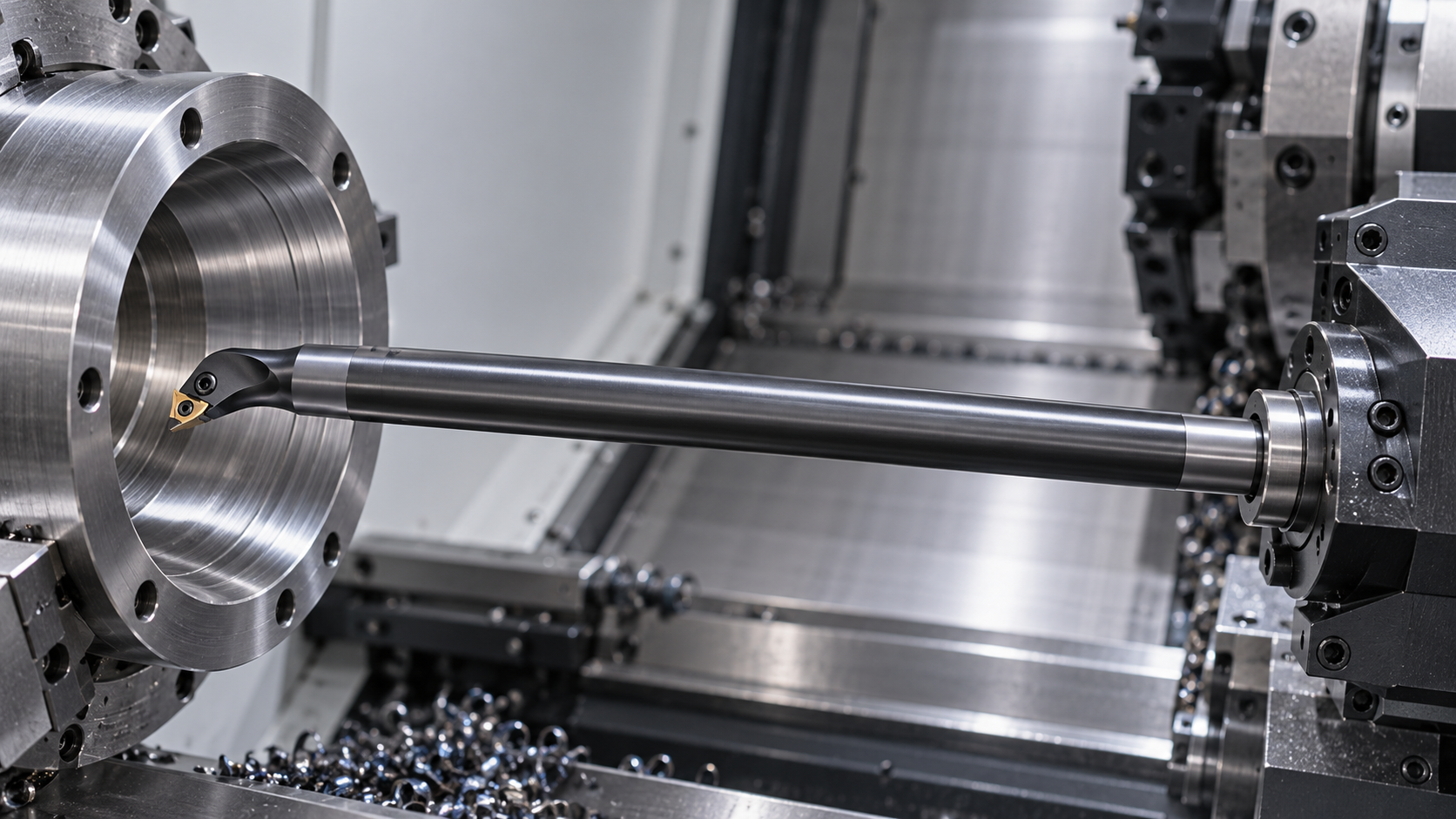
A damped boring bar reduces the dynamic response of a boring assembly; it does not make the assembly infinitely stiff. Damping controls vibration energy, while stiffness describes resistance to deflection under load. Both matter in internal turning, especially when the cutting edge must reach beyond the holder.
Damping and stiffness solve different problems
A cutting force can deflect the bar even when no obvious chatter is present. That static displacement affects where the cutting edge runs. Chatter is a dynamic instability involving the cutting process and the machine–tool–workpiece system. Adding damping can improve dynamic behavior without removing every source of dimensional error.
Think of a slender assembly that bends under a steady load and also rings after a disturbance. Resistance to bending and the rate at which the vibration dies away are related design concerns, but they are not interchangeable claims. An improved finish alone does not establish a particular stiffness or bore accuracy.
What a damped tool may contain
Some manufacturer-specific systems use an internal moving mass and damping elements to oppose or dissipate vibration. Their design, adjustment requirements and working range depend on the system. BIG DAISHOWA describes its Smart Damper as a manufacturer-specific dynamic counter and friction damper. That description should not be copied as the verified construction of another supplier’s bar.
The local damped boring bar listing establishes its intended internal-turning use. It does not establish the mass, fluid, tuning method or internal arrangement. The phrase “shock absorber” in a search query is therefore treated here as an informal description of damping, not a specification for a hydraulic mechanism.
Why setup still limits the result
The complete force path runs from the cutting edge through the head, bar, holder, machine and workpiece support. A loose connection or flexible component elsewhere in that path can dominate the response. The bar also needs enough clearance to cut and evacuate chips without touching the bore wall.
Use the shortest practical projection that reaches the feature, while respecting the system’s permitted working range and clamping zone. Some damped assemblies have configuration-specific limits, so shortening or extending them arbitrarily is not a guaranteed improvement. Ask whether the quoted bar needs tuning or a particular head and holder.
Read performance claims as configuration-specific
| Claim | What to confirm |
|---|---|
| Long-reach capability | Exact diameter, projection, head, holder and operation |
| Improved surface finish | Material, cutting conditions and method of measurement |
| Dimensional stability | Thermal state, wear, deflection and inspection method |
| Adjustable damping | Whether adjustment applies to the actual supplied system |
A supplier’s result from one assembly is useful context, not a promise for every bore. Ask for the conditions behind a claim before using it to select a tool. Avoid specifying “zero vibration”: the practical target is a stable process that meets the required finish and dimensions.
Plan a controlled acceptance trial
Before the trial, record the assembly designation, projection, clamping procedure, material and insert. Choose measurable acceptance criteria from the component drawing. Compare bore size, finish, chip behavior and repeatability under documented conditions rather than judging the sound alone.
If chatter remains, stop and diagnose the complete system. Check seating, insert condition, workpiece support and chip evacuation before making repeated cutting-parameter changes. Change one controlled factor at a time within approved operating guidance. A traceable trial makes it easier to distinguish a setup problem from an unsuitable tool selection.
Frequently asked questions
Does damping increase static stiffness?
Damping and stiffness are different properties. A damped assembly can reduce vibration while still deflecting under cutting load.
Does every damped bar contain the same mechanism?
No. Internal construction, adjustment and working limits are system-specific and must be confirmed for the supplied bar.
Will a damped bar eliminate chatter?
It can help control vibration, but clamping, workpiece support, insert selection, reach and cutting conditions still affect stability.
Related selection resources
Damped internal-turning bar · Holder and interface checklist · Chatter after fitting a damped bar
Technical references and scope
Manufacturer references explain general selection principles or their own systems; they do not certify another supplier’s compatibility or performance. Product ranges above come from the linked local listings. This guide does not replace instructions for the exact assembly. Sources reviewed October 27, 2026.
Technical information is prepared by the Wujinniu CNC tooling team based on product application data and machining requirements.