Choose an anti-vibration boring bar when the required reach remains unstable after the basic setup has been checked, and the supplier can confirm a suitable damped configuration. A solid bar, a damped bar and a modular boring-head holder serve different functions. Start with the operation and support conditions, then compare the tooling. Buying a component labelled anti-vibration does not by itself establish that the complete assembly will meet your bore tolerance or surface-finish requirement.
This guide is a decision overview for CNC internal machining. It helps you decide which tooling route to investigate before moving to a detailed specification or quotation.
First identify what needs to be supported
On a typical CNC lathe, an internal-turning bar carries a cutting edge into a rotating workpiece. On a machining centre, a spindle-mounted boring assembly can include a holder, extension and adjustable head. These arrangements have different connections and clearance requirements. A CT50 holder with a pilot bore is not automatically a damped lathe boring bar, and its pilot diameter is not the finished-hole diameter.
Record the bore diameter, machining depth, entry restrictions and unsupported tool projection. Also record whether the cut is continuous or interrupted. Separate the required cutting reach from overall tool length: they can use different reference points and should not be added interchangeably.
Compare the three tooling routes
| Tooling route | Reason to evaluate it | What it does not establish |
|---|---|---|
| Conventional solid boring bar | A short, well-supported setup that already reaches the feature | No universal depth limit follows from the bar material alone |
| Damped boring bar or damped assembly | Required reach leaves a vibration-sensitive setup after mounting checks | The label does not guarantee a chatter-free cut or a particular productivity gain |
| Modular boring-head holder | A machining-centre assembly needs a verified spindle-to-head connection | A standard holder is not evidence of an internal damping mechanism |
For the mechanism rather than the purchase decision, read how damped boring bars work. Damping and stiffness address different aspects of the dynamic response; an external image cannot verify the internal construction of a particular bar.
Use this decision sequence before changing tools
- Check support first. Clean the mating surfaces, inspect the seating and verify the specified clamping arrangement. Check workpiece support as well as tool support. A loose connection or flexible part needs attention before a new bar can be meaningfully evaluated.
- Reduce avoidable projection. Use the shortest practical unsupported length that still clears the feature and machine envelope. If shortening the assembly is impossible, keep that required reach fixed while comparing alternatives.
- Check the cutting edge and evacuation. Confirm insert compatibility, edge condition and chip clearance for the workpiece material. Use the tool maker’s application recommendations; reducing feed indiscriminately is not a universal chatter remedy.
- Evaluate a damped configuration. Ask the supplier to confirm the bar, cutting head, mounting arrangement and operating envelope as one assembly. Do not transfer a published result from another manufacturer’s tool to the proposed configuration.
If a newly fitted damped bar still chatters, use the separate post-installation chatter checklist to isolate what changed.
Confirm the complete assembly before purchase
A nominal diameter or matching thread is insufficient to prove interchangeability. The locating faces, pilot fit, clamping method and machine interface must also agree. The holder and interface guide covers that connection check in detail. Ordinary modular holders should be described as supporting components unless damping construction is explicitly confirmed.
Compare quotations on the same scope: bar only, cutting head, holder, insert, coolant components and any required accessories. State the required reach and workpiece material in every enquiry. For a detailed application worksheet, use the damped-bar specification checklist.
Agree how success will be checked
Before a trial, define acceptable bore size, surface finish and edge condition. Record the actual projection, workholding, material and cutting data. Change one controlled variable at a time where practical. Compare the result under documented conditions rather than relying on a general claim about quieter cutting. No universal speed, feed, length-to-diameter limit or improvement percentage is specified here.
Frequently asked questions
Is every anti-vibration holder a damped boring bar?
No. A holder can support or connect tooling without containing a damping mechanism. Confirm the function and construction of the selected component.
Should I buy a longer bar to solve a reach problem?
Only after checking the required unsupported projection, clearance and mounting arrangement. Extra length can increase vibration sensitivity; confirm the permitted configuration with the tool manufacturer.
Can I compare tools using advertised depth capability alone?
No. Compare the complete assembly, workpiece, cutting conditions and acceptance criteria. A result from a different configuration does not establish performance in your application.
Explore anti-vibration boring tooling for configuration enquiries. Selection remains application-specific; this guide does not certify an individual product’s damping performance.
Technical references and scope
BIG DAISHOWA’s damping-technology explanation and machining vibration guide support the distinction between damping, support and reach. Their product-specific claims are not specifications for Wujinniu products. Prepared by the Wujinniu CNC tooling team as general selection guidance.
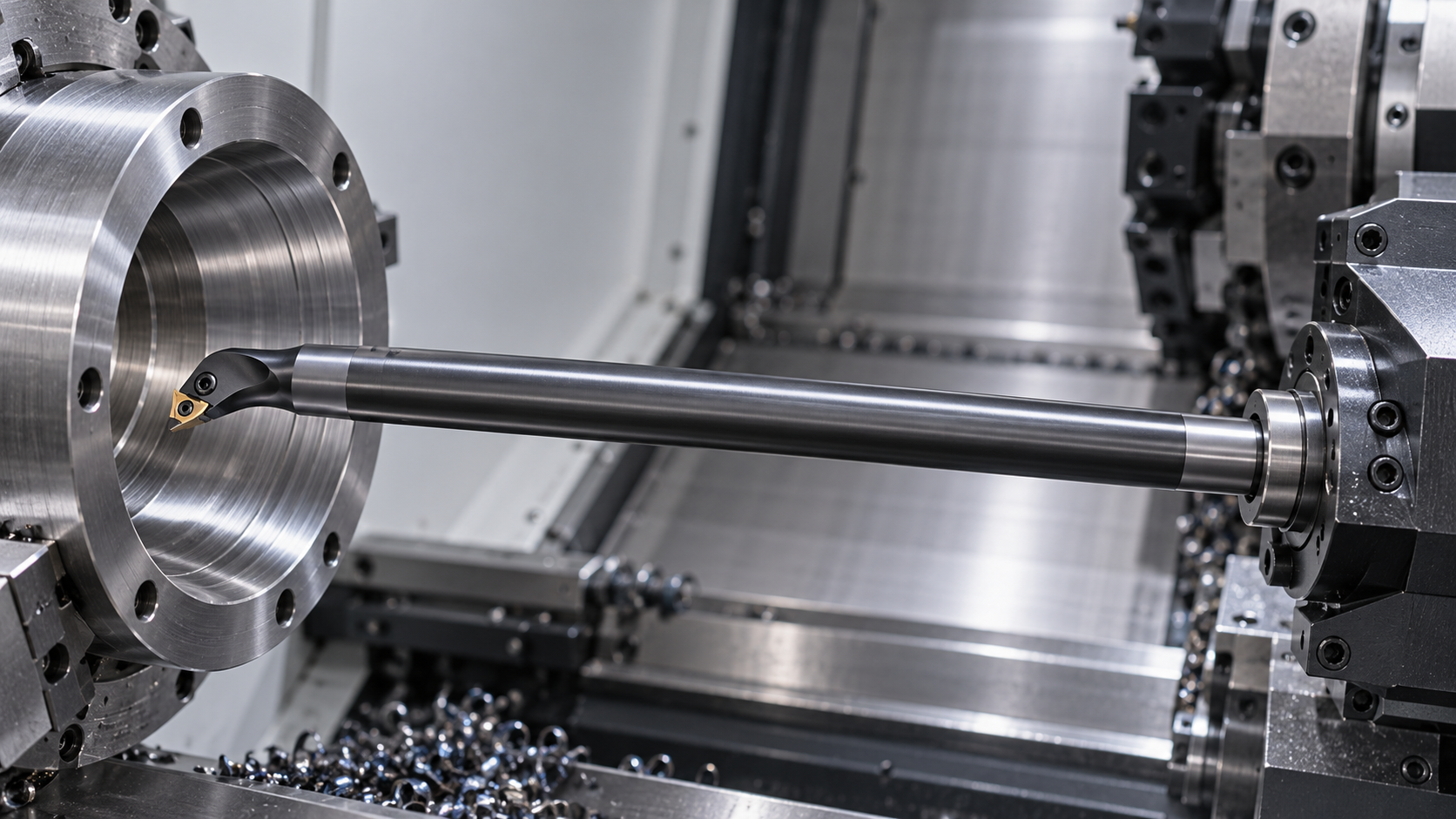
AI-generated illustration reused from the existing boring-tool guide; it is not a product photograph, dimensional drawing or proof of internal damping construction.